Indian National Movement
1.
What was the attitude of the British Government in India towards the Indian Newspapers when the Civil Disobedience Movement was gathering momentum ?
a.
Government tried to curb the freedom of the Press.
b.
Securities of many Indian Newspapers were forfeited.
c.
Both (a) and (b).
d.
Government was liberal in dealing with the Indian Newspapers.
2.
Which or the following factors was responsible for the start of Civil Disobedience Movement in the.cArly 1930's ?
a.
In the year 1929, Government rejected Nehru Report.
b.
Spreading of Socialist Movement.
c.
Great economic depression in the world.
d.
All of these.
3.
Gandhi preached Swadeshi cult. Indians began to boycott foreignt clothes. Which of the following was the effect of this boycott ?
a.
Indian Textile Industry was saved.
b.
Import of foreign clothes was considerably reduced.
c.
Both of these.
d.
Government changed its textile policy.
4.
How the Congress Party reacted to the Gandhi-Irwin Pact ?
a.
It was approved at the Karachi Session of Congress.
b.
It was rejected at the Lahore Session of Congress.
c.
It created dissensions within the Congress Party.
d.
Younger leaders of the Congress left the Party.
5.
Why Mahatma Gandhi chose to break, first of all, the salt laws ?
a.
Because salt was the commonest article of daily consumption.
b.
Because these laws were the cruelest of all the laws.
c.
Because Gandhi knew that it is much easier to succeed in the breaking of these laws.
d.
Because salt was very costly.
6.
What was the immediate aim of Mahatma Gandhi in starting 'Dandi March' ?
a.
To draw attention of the masses towards dictatorial attitude of the Viceroy.
b.
To bring about union of hearts between Hindus and Muslims.
c.
To break salt laws.
d.
To focus the attention of high caste Hindus on the miserable plight of Harijans.
7.
Breaking of salt laws was just a sample act of civil disobedience. What was its reaction ?
a.
Artificial salt was prepared in C.P. and U.P.
b.
Illegal salt manufacture started in Madras,, Bombay and Rengal.
c.
Both of these.
d.
None of these.
8.
In the Gandhi-Irwin Pact, Gandhi agreed
a.
to suspend the Civil Disobedience Movement.
b.
to participate in the Second Round Table Conference.
c.
not to press for enquiry into the police excesses.
d.
to all of these.
9.
What was the attitude of the younger Congressmen towards the manifesto issued, by Congress, after the 'Declaration of Lord Irwin' ?
a.
They thought that the manifesto is very much conciliatory in its approach.
b.
Jawaharlal and Subhas Chandra Bose resigned from the Congress Working Committee.
c.
Jawaharlal and Subhas Chandra Bose declard their stand on 'Puran Swarajya'.
d.
All of these.
10.
How the Congress leaders reacted to the 'Declaration of Lord Irwin"?
a.
They thanked the British Government for this Declaration.
b.
They promised cooperation in the framing of a Dominion Constitution.
c.
They attached a precondition that political prisoners should be freed.
d.
All of these.
General Knowledge
1. World Geography -Test-01
2. World Geography -Test-02
3. World Geography -Test-03
4. Geography of India -Test-01
5. Geography of India -Test-02
6. Geography of India -Test-03
7. Geography of India -Test-04
8. Geography of India -Test-05
9. History of India - Test - 01
10. History of India - Test - 02
11. History of India - Test - 03
12. History of India - Test - 04
13. History of India - Test - 05
14. History of India - Test - 06
15. History of India - Test - 07
16. INM-Test-01
17. INM-Test-02
18. INM-Test-03
Benefits of Honey
Teddy Day
Benefits of Kale
Future Value for Single Payment
Benefits of Chives
Xmas Party Ideas
Beautiful Reasons to Visit Australia
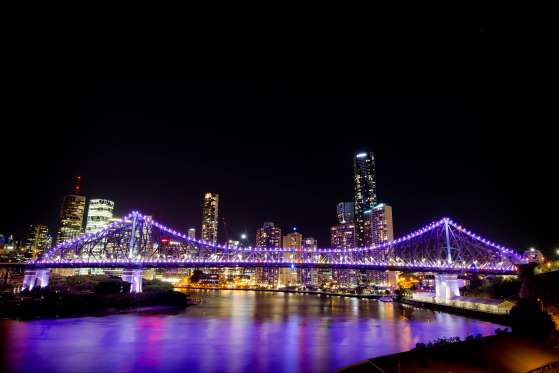
STORY BRIDGE
This bridge is the longest cantilever bridge in Australia. Spanning over the Brisbane River, one can climb on the bridge to take in a breathtaking view of the city and its skyscrapers.